FlashRunner 2.0 HS High-Speed Programmer: Distributed Parallel Programming for Industry 4.0
Product Positioning
The FlashRunner 2.0 HS is a next-generation high-speed distributed programming system innovatively launched by SMH Group, built on 20 years of industry experience and the classic FlashRunner 2.0 architecture. It is specifically designed to meet the demanding requirements of the Industry 4.0 era for high efficiency, high flexibility and high signal integrity, making it the ideal choice for complex boards, high-speed chips and large-scale mass production scenarios.
Core architecture innovation: Control Unit + Active Modules
Unlike traditional all-in-one programmers, the FR2.0 HS adopts an innovative "distributed" or "multi-port" architecture:
| Central Control Unit |
| The brain of the system | Equipped with an 800 MHz dual-core ARM Cortex-A9 high-performance processor, 1 GB DDR3 memory and 256 GB eMMC large-capacity storage, it manages task management, communication scheduling and data storage. | 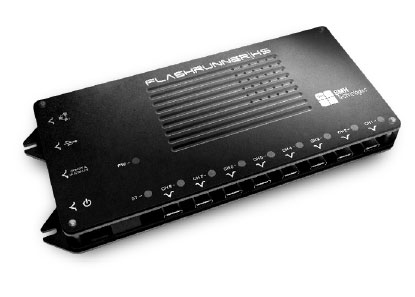 |
| Rich host interfaces | Provides isolated Gigabit Ethernet, USB-UART and parallel control interfaces for easy integration into any automated production line or test environment. |
| Connectivity core | Equipped with 8 USB Type-C ports for connecting downstream active modules. |
| Peripheral Active Modules |
| The "hands" close to the device | Compact in size, they can be integrated directly inside test fixtures and placed right next to the target chip, fundamentally solving the signal attenuation and integrity problems caused by long cables. | 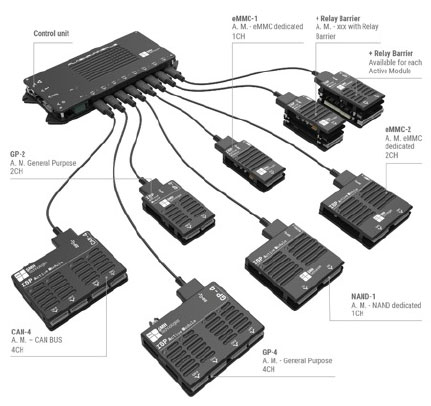 |
| Select on demand, combine flexibly | Users can choose different types of modules to combine according to project requirements, connecting up to 8 modules. |
| Independent power supply and monitoring | Receives data and power (15V/1A) from the control unit via USB-C cables, with voltage and current monitoring of the output power. |
Core Advantages and Value
1. Ultimate Speed and Parallel Capability
Ultra-high communication frequency: Active modules support communication frequencies up to 100 MHz (e.g., eMMC modules), with some protocols exceeding 300 MB/s transfer rates.
Large-scale parallel programming: By pairing with multi-channel modules (e.g., GP-4), a single system can easily program up to 32 chips simultaneously, greatly boosting line throughput.
2. Unmatched Flexibility and Compatibility
Modular protocol coverage: A range of dedicated active modules covers almost all mainstream and specialized protocols:
General-purpose protocols (GP modules): support common interfaces such as JTAG, SPI, QSPI, SWD, I2C and UART.
High-speed memory protocols: specially designed for chips such as eMMC, parallel NAND, OCTO-SPI and UFS to unleash their maximum performance.
Industry-specific protocols: provide automotive bus modules such as CAN/CAN-FD, LIN and Automotive Ethernet (AETH), as well as USB interface modules.
Future expandability: new protocol modules can be easily added to the system, protecting your investment.
3. Ensuring Signal Integrity and Reliability
"Near-field programming" concept: placing active modules inside the fixture keeps the programming interface at the shortest possible distance from the chip, completely avoiding distortion and interference of high-frequency signals over long distances — critical for high-speed buses such as eMMC and DDR.
Industrial-grade connection solutions: custom USB-C cables with locking screws (up to 6 m) and highly reliable industrial connector solutions from brands such as ODU and VPC, guaranteeing over 100,000 mating cycles for high-pace production lines.
4. Powerful Software and Security Ecosystem
Unified software platform: retains the mature FlashRunner Workbench graphical interface, supporting online algorithm updates and cross-platform operation.
Comprehensive security protection: supports project file encryption, tiered permission management and operation log traceability, meeting production security and IP protection requirements.
Seamless integration: DLL libraries and command-line interfaces enable easy integration into third-party MES and automated control systems.
Typical Application Scenarios
Complex board programming: boards integrating multiple chips with different protocols (e.g., "processor + eMMC + CAN chip") can be completed in one pass by flexibly combining GP, eMMC and CAN modules.
High-speed memory chip mass production: high-speed pre-programming or in-line programming of chips such as eMMC and UFS.
Automotive electronics production lines: meets the specific bus programming needs of vehicle controllers for CAN, LIN, Automotive Ethernet and more.
High-density board-level programming: efficient programming of multi-chip, high-bandwidth modules such as memory modules and SSD controllers.
Selection Recommendations
For ultimate speed and signal quality: when chips such as eMMC, UFS or high-frequency QSPI are involved, the FR2.0 HS is the first choice.
For complex protocol combinations: when boards carry diverse chip types requiring multiple specialized protocols, the modular advantage of the FR2.0 HS is evident.
For classic needs and cost optimization: for scenarios dominated by conventional MCUs and SPI Flash with short signal paths, the FlashRunner 2.0 series may be a more cost-effective choice.
In conclusion, the FlashRunner 2.0 HS elevates programming performance, flexibility and reliability to new heights through its disruptive distributed architecture. It is not just a tool — it provides an Industry 4.0-oriented, system-level solution to the high-speed, high-density, high-mix challenges of future electronics manufacturing.

 EN